Start Here
How the Volunteer Literacy Project started, and why we do what do.

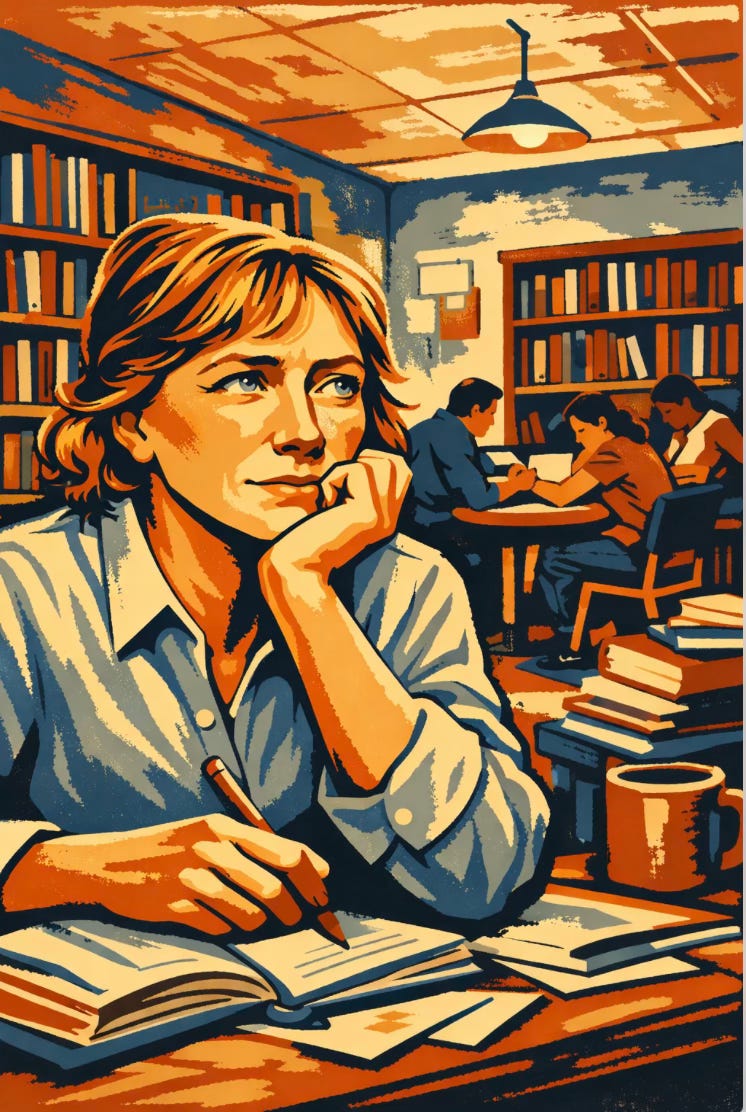
It’s 2007.
I’m running a GED tutoring program in an adult education center in Manhattan when a problem appears that I have no idea how to solve.
We have students who can’t read.
Not poorly. Not slowly. They cannot read at all.
We’re in a room that looks like a shabby, well-used library: bookshelves along the walls, round tables scattered through the space, the quiet hum of studying. Adult students lean over textbooks while volunteer tutors sit beside them, helping with the five-paragraph essay, or fractions and signed numbers.
I’m in my mid-thirties, a mom with young kids, working in a job that landed in my lap after my magazine editing career abruptly ended. I run a tutoring program for adults studying for the GED.
Part of my job is recruiting volunteer tutors. When I first got the job, I thought this was crazy. Volunteers? In Manhattan? What titan of industry would volunteer when they could be hustling their way up the job ladder? But it turns out there’s a whole subculture of volunteers in New York City—and everywhere. Eager college grads who want to give back the help their own immigrant parents received, people practicing their faith or passing time before graduate school or the Peace Corps, or the large group of people who just think volunteering is a good way to live.
I find these people, and I train them. My program is soon bustling. One volunteer tells me that when the room is full it looks like a public relations photo for volunteerism: students and tutors leaning over books together, everyone working hard. The best of humanity.
But something is wrong.
In the corner of the room sits a small group of students who aren’t working. They’re just waiting.
There’s Clive, in his sixties, with rounded shoulders and a deeply lined face. Clarice, a Jamaican mother who has raised three successful daughters but cannot read herself. Nelson, still wearing his work clothes from unloading trucks at Walmart, his jaw clenching and unclenching as he watches the room.
And Hyacinth, who will later become a real friend to me, though at this point she regards me cautiously, waiting to see what I will do.
They all have the same posture: patient, resigned, hopeful.
These students can’t read.
***
At first I assume I can help them, no problem. There must be a well-established way to teach adults to read. Right? Surely someone in the adult education world knows how to do this.
So I begin asking around.
The answers are shocking.
My supervisor shrugs helplessly. Our grant is for GED preparation and college entrance, not basic literacy.
Another administrator wonders aloud whether the students might be intellectually disabled. (She actually uses the R word.)
A director at a respected adult education program tells me he doesn’t think anyone knows how to teach adults to read.
A veteran teacher says it probably can’t be done.
Meanwhile the students keep coming.
Every night they sit at the table in the corner, waiting patiently while I rush past them helping students with algebra or essay writing.
Each time I pass, their faces lift.
Did you figure it out?
Are we going to get to work now?
They are waiting for someone to show them how to read.
But the answer is still no.
I have not figured it out.
Sometimes I try anyway. We struggle through children’s books, attempting to sound out words. The exercise is humiliating and frustrating for everyone involved. It quickly becomes clear that I don’t know how to teach reading—and that the textbooks and GED materials we have are useless for students who can’t read at all.
Eventually I realize that if I want to help them, I will have to learn how to teach reading myself.
I begin studying the research on reading instruction and eventually train in evidence-based methods often referred to as Structured Phonics or the Science of Reading. Over the next several years I begin adapting those methods for adults and for volunteer tutors.
I write lessons. I create materials. I experiment, revise, and rewrite constantly.
It is exhausting work, but slowly the most amazing thing begins happening.
It works.
One day a student and her tutor stop by my desk on their way out. The student has been learning letter sounds and blending them together to read words—something she had never been taught before. She should be happy—but she’s angry.
“Why didn’t anyone tell me this?” she asks.
I have heard that question so many times since. I have no answer. I agree with her, with all of them. Why didn’t anyone tell them? I’m angry too.
***
It’s not long before I begin imagining something bigger. If this method works, why is it so hard to find in the adult education world? Why don’t tutors and literacy programs everywhere have access to these kinds of materials? Looking around, I find again and again that most adult education programs just don’t offer basic literacy. And looking at the very best basic literacy programs, I can see that they aren’t appropriate for adults, and don’t work with volunteer tutors.
My scripted, bare-bones curriculum, created especially for adults, and usable by volunteers, is actually special.
One day, a student and her tutor are gushing to me about the progress they’re making. People come out of a successful tutoring session like they’ve been to church. They stand taller, their shoulders are back, their eyes lit up. These two look like that, so thrilled about how this program actually works.
Caught up in their excitement, I finally say it out loud: “What if I made this into a nonprofit? What if I could share everything we’re doing in here with…everyone?”
The tutor grips her arms with both hands and says she just got chills.
So do I.
That moment became the beginning of the Volunteer Literacy Project.
For nearly fifteen years I have continued to refine the curriculum—and the tutor training—that we first built in that small literacy center. I have adapted the best research on reading instruction into a system that volunteer tutors can easily use and adult students can succeed with.
Today the Volunteer Literacy Project exists to make effective reading instruction available to the millions of adults who still struggle with literacy.
Because somewhere, right now, there is another student sitting at a table like those first students I had in Manhattan—waiting patiently for someone to finally show them how to read.